
The Monsoon Session of Parliament for 2026 is scheduled from July 20 to August 13, with significant political developments expected following recent assembly poll results and internal party rebellions. The session will see the ruling NDA's strengthened position in the Rajya Sabha and potential redrafting of a key Constitution amendment bill.
India's Monsoon session of Parliament remains formally unprorogued 40 days after adjournment, setting a new record. This unusual delay fuels speculation that the government intends to introduce a key legislation, possibly an amendment to the women's reservation law, without convening a new session. The proposed amendment aims for a 50 per cent seat expansion to address concerns over delimitation.

Rajya Sabha Chairman C P Radhakrishnan expressed "deep concern" over the persistent disorder and frequent disruptions that "derailed" the business of the House during the Monsoon Session, leading to a productivity of only 39 per cent.

The Lok Sabha's monsoon session concluded on Thursday, marked by relentless opposition protests over critical issues like the NEET paper leak and police action on students, yet saw the passage of several key bills without extensive debate. Home Minister Amit Shah expressed readiness to debate the student protest issue, urging the speaker to allocate time.

The Monsoon session of Parliament is expected to begin on July 20 and last for three weeks. Key political developments, including recent election victories and party rebellions, are set to influence the session, alongside the government's redrafting of a significant Constitution amendment bill concerning women's reservation and Lok Sabha seats.

Major bills, including those on women's reservation, delimitation, and the Foreign Contribution (Regulation) Act (FCRA), face an uncertain future in the ongoing Monsoon session of Parliament due to persistent opposition protests and a lack of consensus.

An all-party meeting convened by the government ahead of Parliament's Monsoon Session on Sunday saw the entire opposition staging a symbolic walkout over the invitation to rebel Trinamool Congress MPs and a demand for a discussion on the issues of Ram temple donation 'theft', NEET paper leak and mixing of ethanol in petrol.
The Congress party is set to challenge the Modi government on a range of critical issues, including alleged theft of Ram temple donations, 'systemic corrosion' of the education system, and constitutional amendment bills related to delimitation and dismissal of ministers, during the upcoming Monsoon Session of Parliament.

The Indian government and opposition are preparing for a contentious Monsoon Session of Parliament, with key issues including the Constitution Amendment Bill on delimitation and women's reservation, the alleged NEET paper leak, and a row over Ram temple donations set to spark heated debates.

The report of a three-member committee investigating the grounds for the removal of High Court judge Yashwant Varma, following the discovery of burnt currency notes at his residence, will be tabled in the Lok Sabha during the upcoming Monsoon session.

Lok Sabha Speaker Om Birla is set to make crucial decisions regarding the status of rebel factions from the Trinamool Congress (TMC) and Shiv Sena (UBT) before the Monsoon session of Parliament begins on July 20, following demands for their disqualification by their parent parties.

Lok Sabha Speaker Om Birla is set to make crucial decisions regarding the disqualification petitions against rebel MPs from the Trinamool Congress and Shiv Sena (UBT) before the upcoming monsoon session of Parliament. Both parties have sought the disqualification of their defecting members under the anti-defection law, while the Speaker is consulting legal experts and examining precedents to ensure legally sound decisions.

The monsoon session of Parliament will be held from July 21 to August 12, Union Minister Kiren Rijiju said on Wednesday.

The Congress on Wednesday alleged that the government has announced the start of the Monsoon session of Parliament 47 days before it is due in order to run away from the demand of the party and Indian National Developmental Inclusive Alliance (INDIA) for an immediate special session to discuss the Pahalgam attack and the Centre's failure to bring the terrorists to justice.

The Delhi Traffic Police has issued an advisory for heavy vehicular movement and restrictions around the Parliament complex ahead of the Monsoon Session and a planned 'Chalo Sansad' march by the Cockroach Janata Party (CJP). Security has been significantly intensified across New Delhi, with additional personnel, barricades, and checks to manage traffic and maintain law and order during the protest against alleged NEET irregularities.

The Monsoon session of Parliament saw the passage of several key bills in both the Lok Sabha and Rajya Sabha, despite repeated disruptions and adjournments.

The Indian government is reportedly considering increasing the foreign direct investment (FDI) limit in the pension sector to 100 per cent, bringing it in line with the insurance sector. A Bill to amend the PFRDA Act, 2013, is expected in an upcoming Parliament session.

More than half of the bills introduced in the 18th Lok Sabha have been passed by both Houses in the same session, a significant acceleration compared to previous terms, raising concerns about the time available for legislative scrutiny and stakeholder consultations.

India's Monsoon Session of Parliament concluded with significantly low productivity, marked by frequent disruptions and protests from the Opposition, primarily the Congress, leading to minimal debate on key legislation.

The BJP has accused the Congress and its INDIA bloc allies of deliberately disrupting the Monsoon Session of Parliament, alleging that their conduct has prevented discussions on key Bills and exposed the Opposition's 'double standards' on issues such as paper leaks and student protests.
Ten days after both Houses of Parliament were adjourned sine die, the Monsoon session is yet to end formally, giving rise to speculation that the government wants to pass a key legislation without convening a new session.

The govt and the opposition appeared set for a showdown in Parliament's monsoon session.
The stage is set for a showdown between the government and the Opposition over the GST or Goods and Services Tax Bill in the monsoon session of Parliament, which begins on Monday.

Presiding officers of both Houses Lok Sabha Speaker Om Birla and Rajya Sabha Chairman M Venkaiah Naidu on Saturday held deliberations on the logistics of organising the session in the wake of the COVID-19 pandemic. The sources said options were being explored so that both Houses could function simultaneously during the session, and not on alternate days as some sections of the media were claiming.

Rajya Sabha is likely to adjourn sine die after taking up five bills on Wednesday, the sources said on Tuesday. The Lok Sabha, Speaker Om Birla said, will meet at 6 pm on Wednesday instead of the usual 3 pm.

Catch all the latest debates and discussions from Parliament.

Parliamentary Affairs Minister Prahlad Joshi has said that 31 bills will be taken up in the monsoon session. Among these include the Digital Personal Data Protection Bill, 2023.

The situation in Manipur and the Delhi services ordinance are set to dominate the Monsoon session of Parliament beginning Thursday with the Opposition gearing up to raise these issues to corner the government.

Relentless protests by Opposition parties forced the adjournment of the Lok Sabha for the day after the passage of the Bankers' Books Evidence Bill without a debate on Wednesday, with the government accusing them of coming to the House to disrupt proceedings and not for discussion.
The Monsoon session of Parliament concluded after facing disruptions and protests over the revision of electoral rolls in Bihar. Despite the disruptions, the government managed to pass key legislations.
The monsoon session of Parliament is likely to start from the third week of July and conclude by the second week of August, sources said on Tuesday.
For the second year running, the monsoon session of Parliament, usually summoned in July, is unlikely to be held this year as well due to the coronavirus second wave that has gripped India.
The govt and the opposition are set for a showdown in Parliament's monsoon session.
The government is hopeful that the Monsoon Session of Parliament will begin on its normal schedule in July, Parliamentary Affairs Minister Pralhad Joshi said on Tuesday amid the second wave of COVID-19.

The umbrella body of over 40 farmer unions said at a press conference that two days before the session begins, a "chetavani patra" (warning letter) will be given to all the opposition MPs to protest the laws inside the House.

The Monsoon Session of the Parliament is scheduled to commence on Monday and is slated to conclude on October 1. There will be no question hour and private members' business during the monsoon session.

Hectic preparations are underway for the session with several first-time measures because of the COVID-19 pandemic such as testing of all MPs, staggered sitting of Lok Sabha and Rajya Sabha and use of both chambers and galleries to accommodate members while following physical distancing norms, officials said.
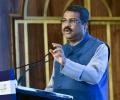
Union Education Minister Dharmendra Pradhan criticised Congress leader Rahul Gandhi for staging a protest outside the Prime Minister's residence regarding the NEET paper-leak issue. Pradhan accused Gandhi of using students as "political tools" to disrupt Parliament, while asserting the government's commitment to discussing NEET concerns in the House. The incident involved Gandhi and other opposition leaders being detained after refusing to end their sit-in.

In the wake of rising cases of coronavirus nothing has been finalised yet and it is will be difficult to specify how the session will be held while adhering to social distancing norms.
Watch all the happens in the two Houses of Parliament LIVE on Rediff.com
